The Free Airway Screening: 13 Signs Your Child May Have a Breathing Problem

Most parents don’t know their child has a breathing problem.

Not because they aren’t paying attention. Because the signs don’t look like a breathing problem. They look like ADHD. Or attitude. Or just “how he is.” The connection between the airway and everything else — sleep, behavior, development, teeth — isn’t something most doctors explain.

That’s why we created the free airway evaluation.

Below is what you’re screening for — 13 signs that your child’s airway may be affecting their sleep and behavior.

The 13 Signs of Sleep Disordered Breathing in Children

Go through this list honestly. Check anything that applies to your child:

During Sleep:

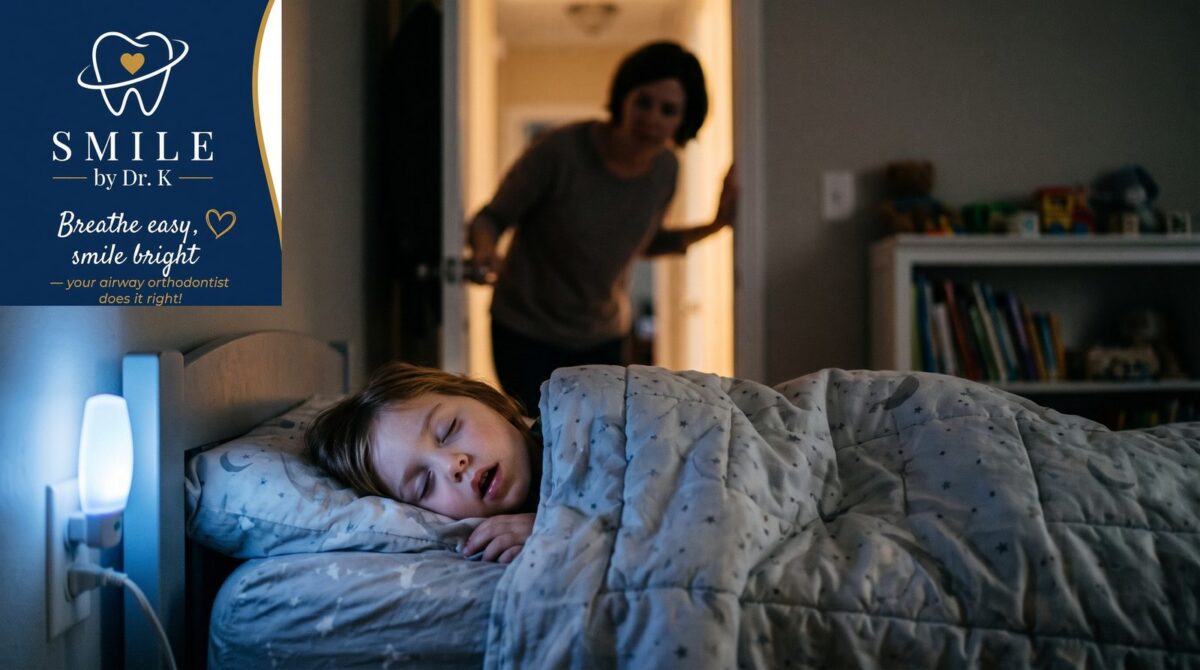
  • Snores — even occasionally, even lightly
  • Breathes loudly or noisily during sleep
  • Mouth breathes while sleeping (lips parted, breathing through mouth)
  • Restless sleep — tosses, turns, kicks, or wakes frequently
  • Sleeps in unusual positions — head tilted way back, chin up, curled neck
  • Bedwetting past the age when it typically stops (usually 5-6)
  • Night terrors or sleepwalking
  • Grinds teeth at night (bruxism) — you can hear it, or dentist has noted wear

During the Day:

  • Mouth breathes at rest — lips apart, breathing through mouth even when calm
  • Chronically congested — always stuffy, always a “cold,” frequent ear infections
  • Dark circles or puffiness under eyes despite seemingly enough sleep
  • Hard to wake up in the morning / falls asleep easily in the car or afternoon

Behavior & Development:

  • Inattention, hyperactivity, or impulsivity — symptoms that overlap with ADHD
  • Emotional dysregulation — meltdowns, low frustration tolerance, mood swings
  • Poor school performance despite apparent intelligence
  • Crowded or crooked teeth — especially a high, narrow palate

How did your child score?

  • 0-2 signs: Low concern. Monitor and check in if things change.
  • 3-5 signs: Moderate concern. An airway evaluation is worth pursuing.
  • 6+ signs: High concern. This pattern strongly suggests SDB. Get evaluated.

What Happens at the Evaluation

If your child scored 3 or more, here’s what to expect at Smile By Dr. K:

  1. A thorough conversation — Dr. K listens to everything. Sleep history, behavior, dental history, family history, prior diagnoses.
  2. A clinical exam — looking at jaw width and shape, palate height, tongue posture and tie, bite, teeth crowding, facial development.
  3. A clear explanation — Dr. K tells you plainly what he sees, what it means, and what options exist. No jargon. No pressure.
  4. A treatment plan, if warranted — tailored to your child’s age, growth stage, and specific findings.

Parents consistently say the consultation alone was valuable — because someone finally connected the dots.

Why Early Matters

The jaw develops most rapidly between ages 4 and 12. During this window, biological expansion is fastest, easiest, and most complete. Treating SDB during this window means less time in treatment, better outcomes, a face and jaw that develop the way they were meant to, and a child who sleeps better, focuses better, and grows up healthier.

Waiting until all permanent teeth come in — which is the traditional orthodontic approach — means waiting until the critical growth window is largely closed.

If your child is between 4 and 12 and has 3 or more signs above, now is the best time to act.

Book a Free Evaluation

The consultation is complimentary. There’s no pressure and no obligation.

Smile By Dr. K — Two Locations:
Northridge (near the 405 & 118 Freeways)
Newbury Park (serving Ventura County)

📲 Call us:
Northridge: (818) 341-5150 | Newbury Park: (805) 498-7785

Book a Free Airway Evaluation →

Dr. Yoram Kohanzadeh is Southern California’s first and only certified airway orthodontist. He has treated patients from age 3 to 67. Breathe easy, smile bright.


Share This With Another Parent

If any of this sounds like a child you know, send them this post. The number of children going undiagnosed with sleep disordered breathing — while being treated for ADHD, allergies, and behavioral problems instead — is staggering. You might be the first person to connect the dots for a family that needed it.

Crooked Teeth Are Not a Cosmetic Problem. They’re a Signal.

Most parents bring their child to an orthodontist for one reason: the teeth look crowded or crooked, and they want them straightened.

That’s a reasonable goal. But stopping there misses the most important question: why are the teeth crowded in the first place?

Answering that question — and treating the cause, not just the symptom — is what separates airway orthodontics from traditional orthodontics.

Teeth Don’t Crowd Themselves

Teeth are crowded because there isn’t enough room for them. The jaw didn’t develop to its full intended width and length, so teeth compete for space — rotating, tipping, and overlapping to fit somewhere.

This isn’t bad luck. It’s biology. And the jaw didn’t develop fully for reasons:

  • Mouth breathing during critical growth years (the tongue rests on the floor of the mouth instead of the palate, removing the pressure that should widen the upper jaw)
  • Prolonged pacifier or bottle use
  • Thumb sucking
  • Early loss of baby teeth without space maintenance
  • Tongue tie that restricted proper tongue posture
  • Genetics — but genetics loads the gun; environment pulls the trigger

The Jaw That Couldn’t Grow Properly

Here’s what traditional orthodontics often doesn’t address: a narrow jaw doesn’t just affect the teeth. It affects everything above and below it.

Above: The upper jaw forms the floor of the nasal cavity. A narrow upper jaw means a narrow nasal airway. Less space to breathe through the nose means more mouth breathing — which further narrows the jaw. The cycle reinforces itself.

Below: A lower jaw that didn’t develop forward enough affects tongue posture, creates a recessed appearance, and reduces the space the tongue has to sit during sleep. A tongue with nowhere to go collapses toward the airway when muscles relax at night.

This is why so many children with crowded teeth also snore, mouth breathe, grind their teeth, and struggle with sleep and attention.

The teeth are the visible signal. The jaw and airway are the real story.

The Traditional Approach — and Why It Falls Short

Traditional orthodontics addresses the symptom: move the teeth to make them straighter. In many cases, this involves waiting until all permanent teeth come in (age 12-13), extracting teeth to create space that the jaw never grew, and using braces or aligners to move remaining teeth into position.

The result can look beautiful. But the jaw is still narrow. The airway is still compromised. The child still snores, still mouth breathes, still struggles with sleep. The root cause was never treated.

Worse: extracting teeth to create space in a jaw that should have been expanded may actually make the airway problem worse by reducing the arch width and further restricting tongue space.

What Airway Orthodontics Does Instead

Dr. Yoram Kohanzadeh approaches crowded teeth as an airway problem, not just a cosmetic one. His evaluation looks at jaw width and length, palate shape, tongue posture and tie, breathing pattern, and sleep quality.

Where expansion is appropriate, Dr. K uses BioX — a biological expansion protocol that encourages the jaw to grow the way it was always meant to, using gentle, sustained forces that mimic the body’s natural development. No extractions. No aggressive forces. The jaw gets the space it needed; the teeth follow.

Early Treatment Changes Everything

The best time to address this is during the growth window — typically ages 4 through early adolescence. During these years, the jaw responds readily to guided growth. Treatment is faster, easier, and more complete.

But adults aren’t out of options. Dr. K has treated patients in their 40s, 50s, and 60s with significant improvements in both jaw structure and airway function. The body is more adaptable than most people believe.

Start With an Airway Evaluation

If your child has crowded or crooked teeth, the cosmetic question and the airway question are the same question. Answer both at once.

Two locations:
Northridge — near the 405 & 118
Newbury Park — Ventura County

📲 Call us:
Northridge: (818) 341-5150 | Newbury Park: (805) 498-7785

Book a Free Airway Evaluation →


Smile By Dr. K | Dr. Yoram Kohanzadeh | Southern California’s First Certified Airway Orthodontist

Mouth Breathing in Children Is Not Normal

Watch your child for a moment. Are their lips parted? Are they breathing through their mouth — right now, at rest?

If yes, that’s not a minor quirk. Chronic mouth breathing is one of the most consequential things that can happen to a child’s developing face, jaw, and brain — and it almost always goes unaddressed.

The Nose Is the Right Tool. The Mouth Is the Emergency Backup.

The nose was designed for breathing. It filters, warms, and humidifies air before it reaches the lungs. It produces nitric oxide, which dilates blood vessels and helps oxygen transfer more efficiently. It drives the proper development of the face and jaw through the pressure of nasal airflow.

The mouth was designed for eating and speaking. When a child breathes through their mouth chronically, they are using the wrong tool — and their body pays the price.

What Mouth Breathing Does to a Developing Face

This is the part most parents — and most doctors — don’t know.

The tongue is supposed to rest against the roof of the mouth (the palate). This upward pressure is what drives the palate to expand sideways and the upper jaw to develop its full width. When a child mouth breathes, the tongue drops to the floor of the mouth. That upward pressure disappears. And the palate narrows.

A narrow palate = a narrow upper jaw = crowded teeth above AND less space for the nasal passage above = more nasal congestion = more mouth breathing.

It’s a cycle. And it reshapes the face in real time.

Chronic mouth breathers often develop:

  • A long, narrow face (sometimes called “adenoid face” or “long face syndrome”)
  • Recessed chin
  • Flat cheekbones
  • Dark circles under the eyes
  • Crowded, crooked teeth
  • Gummy smile (the upper lip can’t fully cover the teeth)
  • Open bite (front teeth don’t touch when the back teeth are together)

These changes happen slowly over years of childhood development. By the time they’re visible, significant structural damage has occurred.

The Sleep and Brain Effects

Mouth breathing at night is strongly associated with sleep disordered breathing (SDB). The mouth is a less efficient airway than the nose — more prone to collapse, more prone to vibration (snoring), and more prone to full or partial obstruction.

A child who mouth breathes at night is often not getting restorative deep sleep, waking partially — without knowing it — multiple times per night, and running a subtle oxygen deficit that affects brain function during the day.

The result looks like inattention, hyperactivity, emotional dysregulation, poor memory, and behavioral problems. Often misread as ADHD. Often treated with everything except the actual cause.

What Causes Mouth Breathing?

Chronic mouth breathing usually has one or more of these roots:

  1. Nasal obstruction — enlarged adenoids or tonsils, chronic allergies, deviated septum
  2. Narrow palate — which itself reduces nasal airway space
  3. Tongue tie — a restricted frenum that prevents proper tongue posture
  4. Habit — mouth breathing becomes self-perpetuating even after the original cause is addressed

The important thing: identifying the cause determines the treatment. Treating just the habit while ignoring the structural cause won’t work long-term.

How Airway Orthodontics Addresses Mouth Breathing

Dr. Yoram Kohanzadeh, Southern California’s first certified airway orthodontist, specifically evaluates mouth breathing as part of every airway assessment. His approach:

  1. Identify the root cause — is it structural, habitual, or both?
  2. Expand the palate and jaws using BioX biological expansion if indicated — creating more space for the nasal airway above and the tongue below
  3. Coordinate with ENT and myofunctional therapists when adenoids, tonsils, or tongue ties are part of the picture
  4. Retrain nasal breathing habits through the treatment process

Early treatment produces the best results — because the face is still growing and highly responsive. But adults can also benefit significantly.

The Sooner You Act, the Less Damage There Is to Undo

Every year of uncorrected mouth breathing during childhood is another year the face develops in the wrong direction. The good news: the jaw is more malleable than most people believe, and treatment can be remarkably effective when started early.

  • Northridge — near the 405 & 118
  • Newbury Park — Ventura County

📲 Call us:
Northridge: (818) 341-5150 | Newbury Park: (805) 498-7785

Book a Free Airway Evaluation →


Dr. Yoram Kohanzadeh | Smile By Dr. K | First Certified Airway Orthodontist in Southern California

Is It ADHD — Or Is It the Airway? What Parents in Northridge Need to Know

Your child’s teacher sends home another note. Can’t focus. Interrupts. Daydreams. Gets frustrated easily. You’ve been to the pediatrician. ADHD is on the table.

Before you go any further — ask one question: How does your child breathe at night?

It sounds unrelated. It’s not.

The ADHD-Airway Overlap Is Real

The American Academy of Pediatrics has acknowledged for years that sleep-disordered breathing in children produces symptoms that are clinically indistinguishable from ADHD. Inattention. Hyperactivity. Emotional dysregulation. Impulsivity. Poor memory. Difficulty following instructions.

These are also the exact symptoms of a child who cannot get restorative sleep — because they cannot breathe properly while sleeping.

A study published in Pediatrics found that children with SDB were more than twice as likely to develop behavioral problems resembling ADHD. And critically: when the breathing was treated, the behavior often improved — without medication.

What’s Actually Happening in the Brain

When a child’s airway is partially obstructed during sleep, their body partially wakes up — sometimes dozens of times per night — to restore breathing. The child has no memory of this. To them, they “slept fine.”

But their brain never got the deep, slow-wave sleep it needed to consolidate memory, regulate mood, restore attention systems, and process the day’s learning. Night after night, this compounds.

The result: a child who looks exactly like they have ADHD. Who may genuinely be struggling with attention. But whose root cause is in the jaw and the airway — not the brain chemistry.

The Signs That Point to Airway, Not Just ADHD

Ask yourself if your child also has any of these:

  • Snores, even occasionally
  • Breathes through their mouth (at rest, during sleep, or both)
  • Has crowded or crooked teeth
  • Grinds their teeth at night (bruxism)
  • Seems tired even after a full night of sleep
  • Has dark circles under their eyes
  • Wets the bed past the typical age
  • Sleeps in unusual positions (head extended back, neck stretched)
  • Has frequent ear infections, chronic congestion, or asthma

If ADHD symptoms exist alongside three or more of the above, the airway deserves serious evaluation before — or alongside — any other intervention.

The Jaw Developed Smaller Than It Should Have

In most cases of childhood SDB, the underlying problem is a jaw that didn’t develop to its full intended size. This narrows the space available for the tongue and creates a smaller, more collapsible airway.

This isn’t a character flaw or bad luck. It often traces back to prolonged bottle feeding or pacifier use, thumb sucking, early mouth breathing (which itself reshapes the face over time), genetics, or tongue tie (ankyloglossia) that was never treated.

The crooked teeth you see are the tip of the iceberg. The jaw that created them is what matters.

What Airway Orthodontics Does Differently

Dr. Yoram Kohanzadeh — Southern California’s first certified airway orthodontist — doesn’t just straighten teeth. He evaluates the jaw’s relationship to the airway and, where appropriate, uses biological jaw expansion to create more space.

His protocol, BioX, works with the body’s own growth mechanisms to develop the jaws gently and naturally — at any age. Younger children respond fastest, but adults can and do benefit too.

This isn’t experimental. It’s what orthodontics should have been doing all along.

The First Step Is Free

Before a diagnosis. Before medication. Before anything else — get a complimentary airway evaluation. Two locations serving the San Fernando Valley and Ventura County:

  • Northridge (near 405 & 118)
  • Newbury Park — Ventura County

📲 Call us:
Northridge: (818) 341-5150 | Newbury Park: (805) 498-7785

Book a Free Airway Evaluation →


Smile By Dr. K | Dr. Yoram Kohanzadeh | Southern California’s First Certified Airway Orthodontist

Does Your Kid Snore? It Could Be Sleep Disordered Breathing — Not Just a Cute Habit

You tuck your child in. Ten minutes later, you hear it — that low rumble coming through the wall.

You’ve asked the pediatrician about it. They said it was normal. Maybe he’d grow out of it. Maybe it’s allergies.

Here’s what they probably didn’t tell you: children are not supposed to snore. Snoring in a child isn’t cute or harmless — it’s a signal that something is interfering with the airway during sleep. And that something has a name: Sleep Disordered Breathing, or SDB.

What Is Sleep Disordered Breathing (SDB)?

Sleep Disordered Breathing is an umbrella term for any pattern where a child’s breathing is disrupted, reduced, or obstructed during sleep. It ranges from simple snoring all the way to obstructive sleep apnea — and everything in between is worth paying attention to.

When a child can’t breathe properly at night, their body can’t complete the deep, restorative sleep cycles it needs to grow, develop, and regulate behavior. The effects don’t stay in the bedroom. They show up everywhere.

The Signs Most Parents Miss

SDB doesn’t always look like snoring. In children, sleep disordered breathing can show up as:

  • Snoring or noisy breathing during sleep
  • Restless sleep — tossing, turning, waking frequently
  • Bedwetting past the age when it should have stopped
  • Night terrors or sleepwalking
  • Mouth breathing (open mouth, even during the day)
  • Dark circles under the eyes despite “enough” sleep
  • Daytime fatigue — falling asleep in the car, hard to wake up
  • Difficulty focusing, hyperactivity, or irritability that looks exactly like ADHD
  • Crowded or crooked teeth — yes, really (more on this in a moment)

If three or more of those sound familiar, your child may be dealing with SDB.

The Jaw Connection Nobody Explains

Here’s where it gets important — and where most pediatricians and general dentists stop short.

Sleep disordered breathing in children is almost always connected to the size and development of the jaw and airway. A jaw that didn’t develop fully — whether due to genetics, prolonged pacifier use, thumb sucking, bottle feeding, or mouth breathing itself — creates a smaller space for the tongue and airway structures. That narrowing is what causes the snoring, the restless sleep, and the cascade of symptoms that follows.

This is why the teeth matter. Crowded, crooked teeth are not just a cosmetic problem. They are often a visible sign that the jaw didn’t develop the space it needed. And if the jaw is narrow, the airway is narrow.

Why This Is an Orthodontic Problem

Most people think of an orthodontist as someone who straightens teeth. But airway-focused orthodontists — like Dr. Yoram Kohanzadeh, Southern California’s first certified airway orthodontist — look at the entire system: the jaw, the bite, the tongue posture, and the airway.

The goal isn’t just a straight smile. It’s a jaw that developed properly, an airway that stays open at night, and a child who can finally sleep — and breathe — the way they were designed to.

Dr. K uses a protocol called BioX — a biological approach to jaw development that works with the body’s natural growth process, not against it. No aggressive forces. No extractions. The body leads; the appliance guides.

The earlier treatment begins, the better. Children as young as 3 have been treated successfully. But it’s never too late — Dr. K’s oldest patient was 67.

What To Do Right Now

If your child snores, mouth breathes, or has any of the symptoms listed above, don’t wait for them to “grow out of it.” The jaw stops growing. The window for the easiest intervention closes.

We see patients at two locations:
Northridge — near the 405 & 118 Freeways
Newbury Park — serving Ventura County

📲 Call us:
Northridge: (818) 341-5150 | Newbury Park: (805) 498-7785

Book a Free Airway Evaluation →


Dr. Yoram Kohanzadeh is the first and only certified airway orthodontist in Southern California. He treats patients from age 3 through adulthood at Smile By Dr. K in Northridge and Newbury Park, CA.